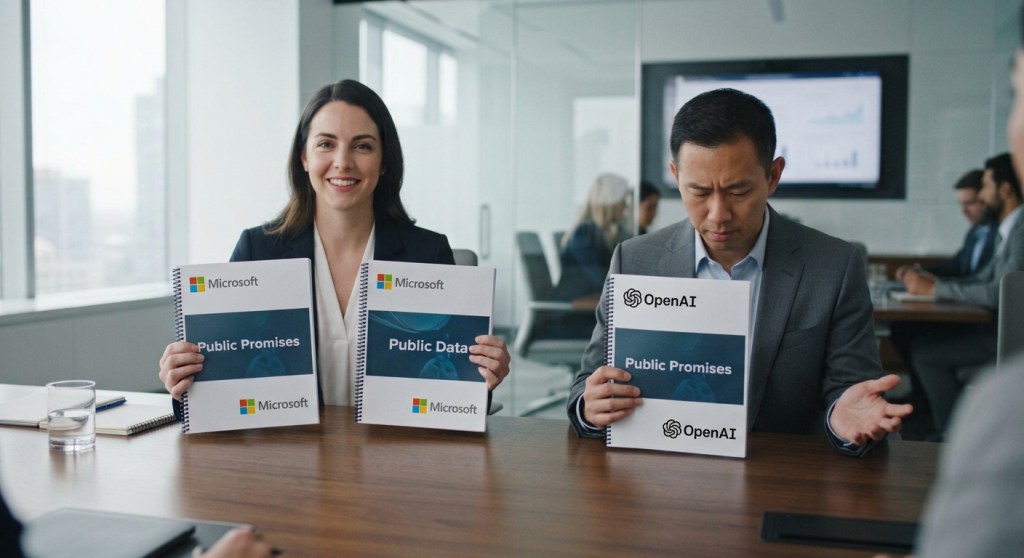
Earlier this month, in response to the growing bipartisan opposition to data center projects, ChatGPT’s owner OpenAI announced a program called OpenAI’s National Community Compact: Building With Communities, Not Just In Them. It followed in the footsteps of other firms with major data center projects, such as Microsoft, which announced a similar program earlier this year called Building Community-First AI Infrastructure.
Should stakeholders with concerns about the public interest be impressed by OpenAI’s guarantees? Its new Compact does address noise, water, energy, economic, and other issues. In this respect, OpenAI’s program is quite similar to the one announced earlier by Microsoft.
The significant difference between the programs of the two firms, though, cannot be found in the programs themselves. For many years, Microsoft has been publishing annual sustainability reports that report operational data in accordance with global accounting standards. Furthermore, Microsoft has been employing the Big Four global accounting firm Deloitte to perform (and publicly report on) limited assurance procedures regarding relevant selected operational data.
Does OpenAI do so? No, not at all. It does not publish annual sustainability reports. In fact, if it continues to decline to produce such information, it may fail to comply with California’s new SB 253 legal requirement to publish certain carbon emissions data.
Thus, an important lesson emerges when we compare OpenAI’s pledges regarding its data center operations to those of Microsoft. Namely, it is misleading to simply compare the programs of the firms without reviewing the related accounting functions. Indeed, we must also compare evidence that the firms can (and do) define, measure, and publicly report the data that is needed to manage relevant company operations.
In this case, if we simply compare programs, we may mistakenly conclude that Microsoft’s and OpenAI’s data center pledges are very similar in nature. However, if we also review public data reports, we can see that Microsoft continues to publish operational information that has never been shared by OpenAI.
To be fair, OpenAI is undoubtedly capable of developing these data functions, and might be presently doing so. Stakeholders with concerns about data centers, though, would be well-advised to focus on the actual reporting practices (or lack thereof) of data center entities instead of simply assuming that the firms are complying with their own proclaimed pledges.
