On January 13, 2026, Microsoft published a data center manifesto called Building Community-First AI Infrastructure. The document described five commitments that purportedly expressed an intention to “be a good neighbor” and adhere to a “sense of civic responsibility.
The manifesto certainly didn’t deter the current bipartisan backlash against the data center industry. On August 23, 2026, Texas Governor Greg Abbott explained that he reversed his initial support of the industry because “they basically dug their own grave … and that’s why they got the backlash they deserve.”
His position is very similar to that expressed by Pennsylvania Governor Josh Shapiro. On August 18, 2026, he explained his own reversal of initial support by noting that many data center developers “have no regard for local communities” and take action by “being aggressive with township officials, bullying our neighbors, and refusing to listen to the people …”
Why didn’t Microsoft’s manifesto deter such angry reactions? One reason may be that each of its five commitments included at least one significant accounting ambiguity that damaged the credibility of the entire document. For instance:
The first commitment promised that the firm would “pay our way to ensure our data centers don’t increase your electricity prices.” The descriptive detail, though, only went so far as to promise to pay “the costs of adding and using the electricity infrastructure needed for the data centers.”
A good accountant, however, would note that there are different ways to calculate such costs. The cost of adding capacity to existing power plants, for instance, is usually much different than the cost of building new power plants from scratch. Although Microsoft has opted for different approaches (to adding capacity) for its various projects, it did not refer to its experience (and its complex historical data) in its manifesto.
The second commitment promised that the firm would “minimize our water use and replenish more of your water than we use.” By definition, though, even a 100% closed water system with 100% recycled water would need to produce new water from scratch (or transport water from elsewhere) to literally return “more” (than what it uses) to the water supply. Microsoft did not promise to do so for each project.
So what did Microsoft mean by its second commitment? The firm suggested a number of activities for generating new water, including the repair of water system leaks and the restoration of wetlands. It is implausible, though, to assume that a sufficient amount of such improvements could be found in close proximity to each data center to ensure that its Ratio of Water Replenished to Water Used exceeds 1.0.
The final three commitments promised to create jobs, add to the local tax base, and invest in AI training and nonprofits. However, the firm did not commit to any specific quantitative targets in any of the three areas. In addition, certain descriptive details appeared to be ambiguous about the economic impacts of promised outcomes.
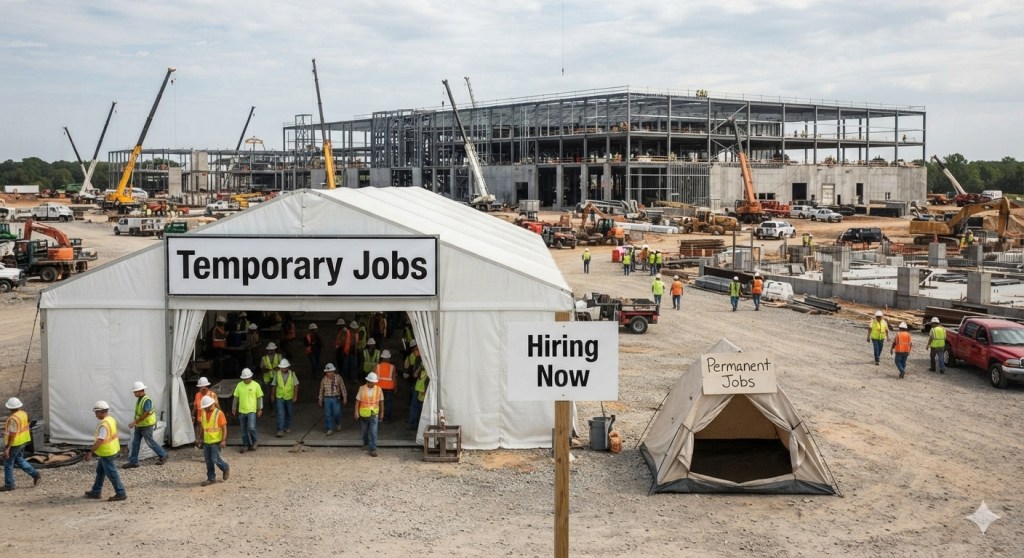
Consider, for instance, the firm’s promise to create jobs. On June 17, 2026, Morgan Stanley reported that the AI data center “jobs story is real, but front-loaded.” It quoted a Virginia report that “a 250,000 square foot data center can support more than 1,500 workers during the construction phrase … (but such) data centers employ only 50 full-time workers once operational.” It also quoted Illinois and Oklahoma reports that estimated even smaller respective operational work forces of 20 workers and 10 workers per data center.
Admittedly, all jobs create some level of economic activity. A good accountant, though, would note a vast difference in value between a project with 1,500 permanent workers versus one with 1,500 temporary workers (albeit with a few dozen additional permanent workers). Microsoft did not address such concerns when it promised to “create jobs” in its manifesto.
To be sure, none of Microsoft’s five commitments are individually harmful to communities. In the aggregate, they would undoubtedly add some level of positive value to any community. The accounting ambiguities that are included in each commitment, though, may explain why the manifesto was unable to deter the current bipartisan backlash against data center organizations.